
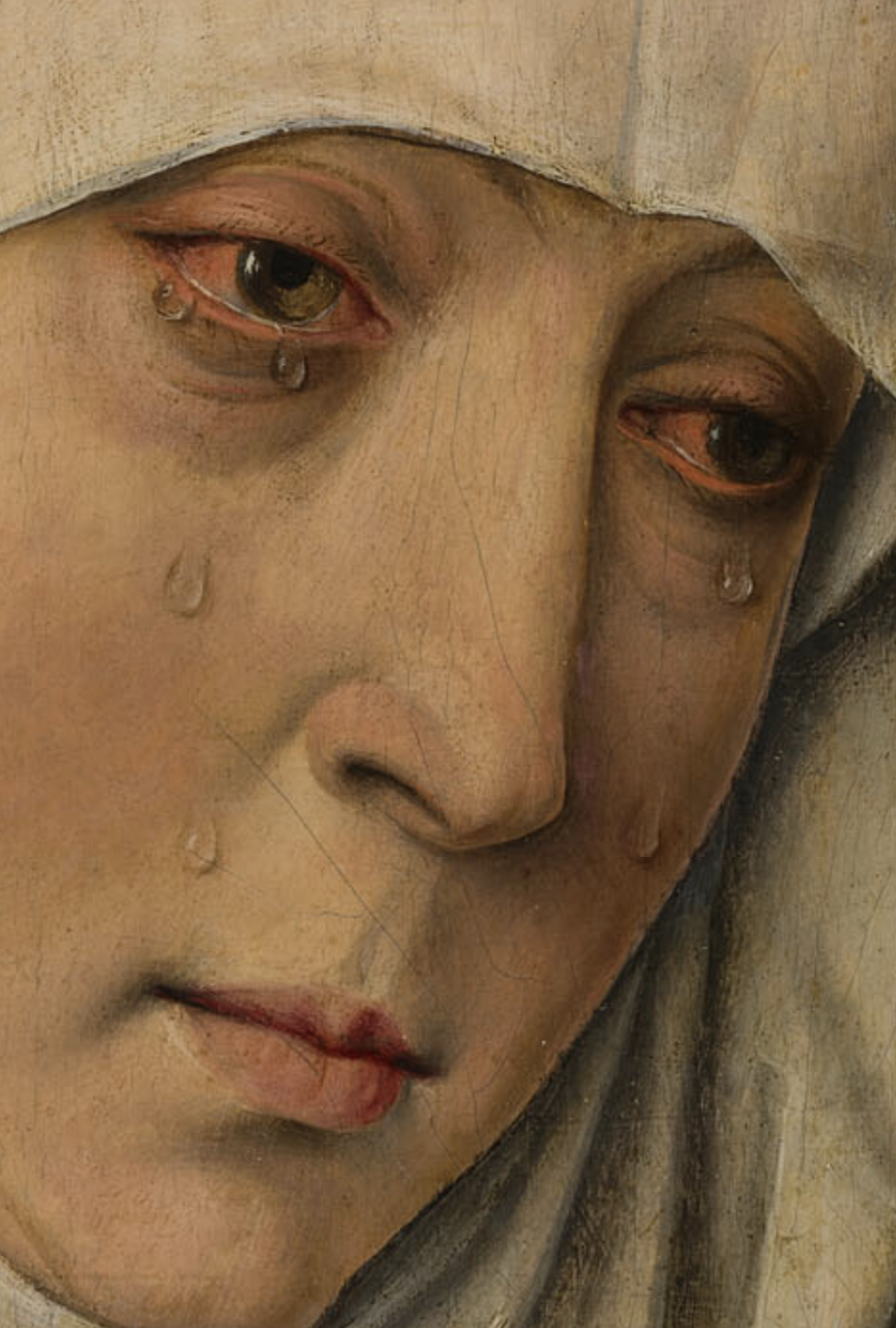
Ne- (nē- geen) penthe (penthos- verdriet)
Sadness has many faces: from small, fleeting disappointments to an overwhelming state of mind. It is a basic emotion that we can identify at a very young age and that lasts a lifetime. For a long time, tears, as a culturally embedded symbol, seemed to be exclusively human. Nowadays, there is broad recognition, both socially and scientifically, that animals can experience sadness as well as pain.
This brief reflection is not intended to unravel human sadness neurologically or psychologically. It would be impossible, even pedantic, to attempt to describe or analyse the many manifestations of grief here. The inspiration for this group exhibition began with that intriguing, visually poetic word itself: Nepenthe. Not so much for its ancient Greek meaning as recorded in Homer's Odyssey (where it was a substance that, mixed with wine, dispelled grief when ingested), but for the enchanting, mysterious power attributed to it in tradition. Namely, that this mythical elixir plunges consciousness into a state of oblivion.
Neither the fight against grief nor grief itself is the central theme here; the research focuses on the effect of the concoction, the process. How does this oblivion actually come about, what exactly happens? And is it desirable to extinguish painful memories? Because perhaps grief itself is a comforting remedy, an intuitive and biologically driven reflex that enables us to process pain.
The question raised here is whether art can stretch or slow down our experience of linear, conditioned time (Chronos), allowing memories to fade and us to become absorbed in an elusive but meaningful moment (Kairos). In other words: can art itself bring about a Nepenthe effect?
In addition to sadness being an internal, subjective emotion, we can also recognise it in all its forms in others, share it and show compassion. This means that sadness is not only an individual experience, but also a shared, intersubjective experience. Intersubjectivity refers to the shared experiences, meanings and realities that arise between people. It is not about private experience (subjective) or objective (factual, provable) perception, but about what we collectively experience as true, meaningful or real.
For example, a banknote is in itself a piece of paper, but it has value among people who have agreed on it and jointly believe in its value. That shared belief makes it a functional medium of exchange. Another example is religion or ideological belief; belief systems gain a foothold and create a collective identity because a community collectively experiences them as meaningful.
Colour perception* is also intersubjective: we do not know exactly what another individual perceives or experiences. Although every colour has many shades and looks slightly different (scarlet red is different from burgundy), everyone understands what you mean when you say red; we understand the broader, generally accepted image of the colour. In order to connect with others, we are evolutionarily attuned to a shared social reality, with all its useful fictions such as money and belief systems.
Art is also part of a collective experience. The arts create a dialogue between the creator, the work or performance, and the viewer. It is a triangular relationship because art itself functions as an active participant, making it more than just a physical object or performance (dance, music, recitation), namely a meaningful entity in that relationship.
*In addition to colour perception, colour can also be scientifically determined in different wavelengths.
“Sharing stories heals, not in the sense of dispelling pain, but through experiencing non-linear time.”
The arts also create shared experiences. In that process, the linear perception of time as measurable causality can be influenced. Our perception of time seems to change when we share time. The book you devour, the silence between the notes, the space between the lines, the moment before the curtain rises, the infectious laugh, a comforting taste sensation, disappear into dance; in those moments, we are no longer trapped in conditioned clock time.
What can broaden the experience of art is that language is not necessary to experience or share it; it transcends the need to name and explain. The world does not end at the limits of our knowledge; where that ends, imagination begins. This means that art can also be experienced pre-reflectively. Pre-reflective (or pre-cognitive) is the direct, immediate experience of something before you consciously think about it or analyse it. The experience has not yet become a concept of thought; you are simply present in the situation. Without words, without perception of time.
Frans Blanker
Zierikzee, February 2026

Bibliography::
Homerus - ‘Odyssee’, ca. 8th century BC.
Ludwig Wittgenstein - ‘On Colour’, original edition (1977, posthumous) ‘Bemerkungen über die Farben’, Basil Blackwell - Oxford.
Hannah Arendt - “The Human Condition”, original edition (1958), The University of Chicago Press.
William James - “The Principles of Psychology”, (1890) Henry Holt and Company - New York.
Interesting links (Dutch only):
• Muziek als medicijn
https://erasmusmcfoundation.nl/muziekalsmedicijn/
• Kunst in de zorg
Image: Dieric Bouts (c. 1470–1475) ‘Mater dolorosa’.